The Heart-Opening Power of Looking Deeply at the Language We Use Around Pregnancy and the Perinatal Period
NURTURING
How often do you hear the word “nurturing”?
Probably pretty often. We use it all the time. Nurturing self-care. Nurturing our children. Nurturing new parents.
But what does it really mean in practice? What does nurturing behavior look like? What does it feel like? How do we give it? How do we receive it? Is it different for everyone? Are some elements so common as to be universal?
As a writer and public radio producer, I love words and language. As the mother of two adult children and the author of Mothering the New Mother: Women’s Feelings and Needs After Childbirth, I am especially passionate about expanding the vocabulary we use when we support parents throughout the perinatal period. Often the language we use or hear is superficial and limiting. We don’t go very deeply into conversations about how to best prepare for this enormous transition. We give lip service to words like “nurturing” without exploring the words in depth. Sometimes, the language we hear is negative, even inaccurate -- for instance, the word postpartum, which in Latin means literally, “after birth” or “after bringing forth”, but has come to be synonymous with “depression”.
Against this backdrop, I was eager to try an experiment: I wanted to mine the word “nurturing” for new and hidden riches. And when I think about enriching the language we use to talk about pregnancy and the perinatal period, one of the first people I think of is Jane Arnold. I first met Jane in New York City in 1987, shortly after the birth of my first child. Jane, then the mother of four, was running the Mom Service, one the of first postpartum doula services in the country (she started it in 1981) and simultaneously on studying to become a Certified Nurse Midwife. Jane steered me to Dana Raphael’s book, the Tender Gift: Breastfeeding, in which Dana introduced the concept of the doula — the person who mothers the mother. Sorely lacking such a person in my own new mothering experience, I turned my quest for doula figures into a National Public Radio documentary on Supportive Postpartum Traditions in Diverse Cultures. I knew I had to include Jane in the show, and we have stayed in touch. Since that first meeting, Jane has gone on to teach at university level and to do trailblazing work all over the world in support of midwifery and dignity in childbirth. Her knowledge and experience are vast. Her voice is strong and sure. It is also poetic, compassionate, and reassuring.
So when I had the pleasure of talking to Jane a few years ago, language was at the forefront of my mind. Here’s what I asked her:
We often use the word “nurturing” to describe the kind of care and help new mothers need. What does that actually mean? What qualities come to mind when you think of a “nurturing” caregiver or helper?
Jane thought for a minute, then slowly articulated a loving, heart-centered list…
“…They smile at you
…They hold your hand and say beautiful words to you
…They use reassuring words
…They treat you with loving kindness
…They provide you with information you ask for or need…”
In that expansive conversation, we had started exploring the attributes of “nurturing”. As a result, a whole new set of touchstones for expectant or new parents to wish for and caregivers to offer had emerged. It was so critical, yet so simple: we were simply taking the time and space to discover. To allow the unspoken to become spoken. It seemed to me that the experience of having unexpressed feelings, needs, wishes, fears, vulnerabilities just below, sometimes far below the surface, characterizes so much of the new parent’s journey. There’s just no time, no place, no inquiry at this level. Even if we take it one word at a time – and I think that’s how we should take it -- it is so important to provide a safe space for parents-to-be and new parents to learn about themselves and their deepest needs during this vulnerable and transformative time in their lives.
This conversation with Jane marked the beginning of a new mission for me: plumbing the depths of the words we use around the perinatal period. I repeated this “nurturing” exercise when I met with a group of birth and postpartum doulas at a training session led by Betsy Schwartz, veteran doula trainer, creator of Doula Quest, Reiki Master, and creator of the board game Down the Canal: The Game of Birth. I asked the group for words that came to mind for them when they thought about the qualities of a nurturing caregiver or helper. We made a list:
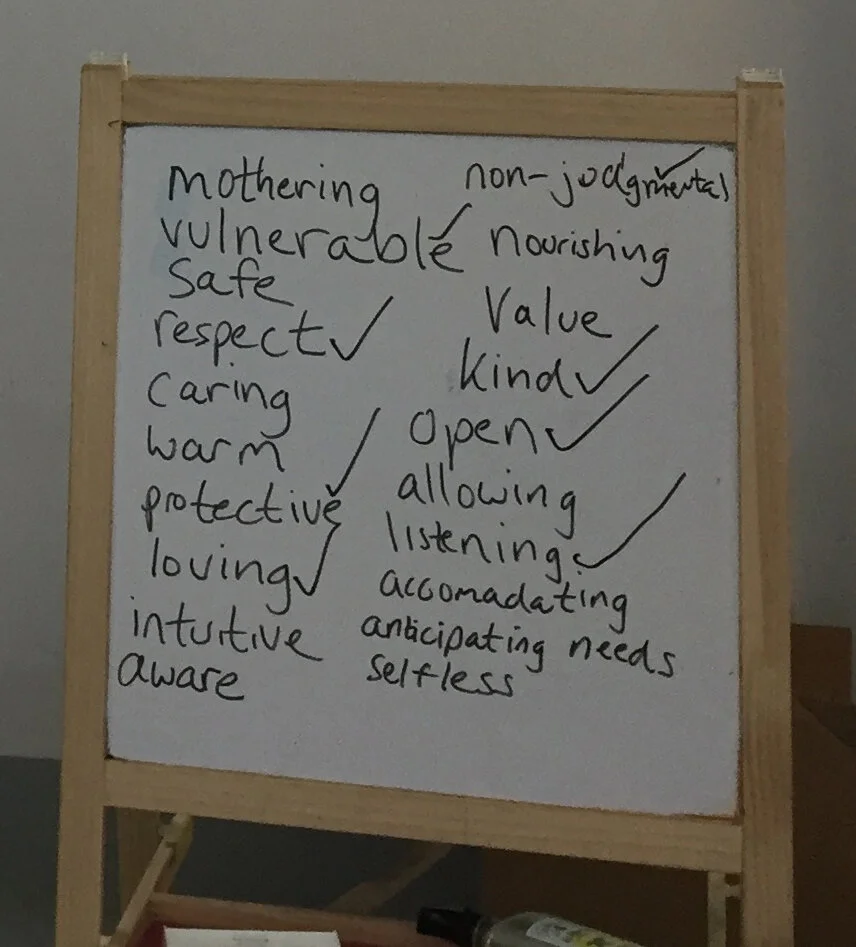
Nurturing qualities identified by a group of doulas in my workshop.
I love asking expectant and new parents, doulas, and other perinatal caregivers this same question. Defining these deep needs and the behaviors that honor them is eye-opening and, even more importantly, heart-opening. Expanding the conversation about “nurturing” gives people a richer, more nuanced repertoire of behaviors and loving expressions to bring into their own and each other’s lives.
These words – the list Jane articulated, the list the doulas made, the lists you will make – these words are our new building blocks. They can help us all, both the receivers and the givers of nurturing behavior, create a richer, more detailed map of the perinatal landscape. I can’t wait to discover, along with you, this new and fertile ground that holds the promise of being gentler, more accurate, more responsive, and, ultimately, more truly nurturing.
What actions or behaviors make you feel nurtured? Drop in comment on my IG page